
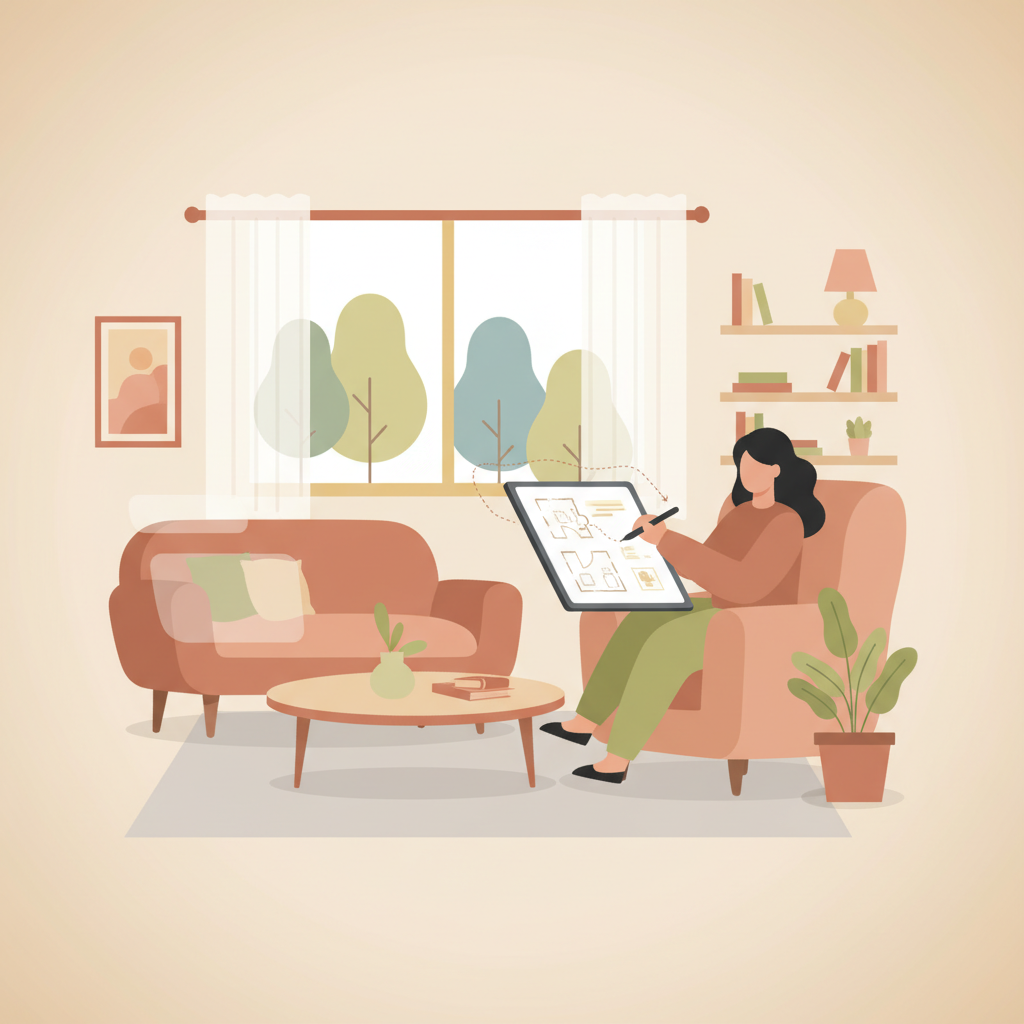
Do you ever find yourself trying to picture how furniture will fit in a room or imagining the flow of a space while decorating? As a home decorator, being good at understanding space is essential, but sometimes it can be a real challenge to boost those spatial skills.
The great news is spatial skills are not fixed traits—they can be improved with practice. Incorporating simple daily habits focused on spatial reasoning into your routine can help you visualize, plan, and design spaces more effectively and creatively.
This article will share three easy daily habits that home decorators can use to boost spatial skills and become more confident in creating beautiful, functional interiors.
Your 3 Daily Habits to Boost Spatial Skills
Habit 1 — Sketch Your Space
Why: Sketching helps you translate 3D spaces into 2D drawings and strengthens your ability to visualize different perspectives, which is crucial to boost spatial skills.
How: Spend 10 minutes daily drawing a part of your room or an imagined interior. Try different angles, include furniture, and play with proportions.
Cue: Set a reminder right after your morning coffee or while listening to music.
Habit 2 — Mentally Map Your Environment
Why: Creating mental maps improves your ability to understand spatial relationships and pathways without relying on digital tools.
How: Before going out or decorating a room, pause and try to mentally visualize the layout and pathways. Challenge yourself to recall room adjacencies or plan new arrangements in your mind.
Cue: Use your commute or daily walk as a moment to practice mental mapping.
Habit 3 — Play with Three-Dimensional Objects
Why: Manipulating physical objects like building blocks or simple models trains your brain to think spatially and understand how parts fit into wholes.
How: Keep a small set of modular blocks, LEGO, or puzzle pieces nearby. Spend a few minutes assembling, disassembling, or experimenting with new shapes.
Cue: Use short breaks during your workday to engage with these objects for a quick mental refresh.
Week 1 Schedule
| Day | Habit 1 | Habit 2 | Habit 3 |
|---|---|---|---|
| Monday | Sketch living room corner | Mentally map your route to work | Build a simple block tower |
| Tuesday | Draw furniture from a new angle | Visualize your kitchen layout | Try a small LEGO structure |
| Wednesday | Sketch a 3D shape from memory | Mentally plan an alternate furniture arrangement | Complete a puzzle section |
| Thursday | Draw a room you visited recently | Visualize pathways in your home | Experiment with block shapes |
| Friday | Sketch an imaginary room | Mentally map a place in another city | Build a small model or puzzle |
| Saturday | Draw furniture layouts quickly | Visualize how objects fit in your space | Play with LEGO or blocks |
| Sunday | Draw a simple floor plan | Mental walk through your home | Assemble puzzle pieces |
Troubleshooting
Barrier: Finding time daily can feel overwhelming.
Fix: Tie your boost spatial skills habits to existing routines like coffee breaks or commutes to make them easier to maintain.
Barrier: Feeling unsure how to start sketching or mentally mapping.
Fix: Use simple prompts like drawing a chair or walking through one room mentally, then gradually increase complexity over time.
Barrier: Losing motivation if progress seems slow.
Fix: Remind yourself that even brief daily practice builds your brain’s spatial pathways and celebrate small wins along the way.
FAQs
Q: How long before I notice improvement in my spatial skills?
A: With daily habits, many notice progress within a few weeks as their brain gets better at spatial visualization and reasoning.
Q: Do I need to be good at drawing to sketch my spaces?
A: No! Sketching is about practice, not perfect art. Even simple lines and shapes help improve your spatial skills.
Q: Can these habits help with professional design work?
A: Absolutely. Boost spatial skills gradually enhance your abilities to visualize, plan, and troubleshoot design challenges, benefiting your work quality.
Tracking & Motivation Tips
Keep a simple journal or digital note to track your daily boost spatial skills habits. Celebrate streaks and note which activities feel most rewarding. Sharing your progress with a friend or fellow decorator can also keep motivation high.
Key Takeaways for Boosting Spatial Skills
Boosting spatial skills as a home decorator is totally possible by building simple habits into your daily routine. Sketching your space, mentally mapping environments, and playing with three-dimensional objects provide fun, accessible ways to train your brain. Consistency is key so start small, stay curious, and watch your skills grow to create even more inspiring spaces.