
Finding yourself wobbly during a pirouette or struggling to hold a pose longer than a breath can be frustrating for any dancer. Balance is a key skill that underpins graceful movement and control across every dance genre.
Luckily, improving balance does not require hours of complicated training. Simple, consistent daily habits focused on key muscles and body awareness can make an enormous difference.
In this article, you will discover three easy daily habits any dancer can do to steadily improve balance, stability, and overall poise on and off the stage — no fancy equipment necessary.
Your 3 Daily Habits To Improve Balance
Habit 1 — Airplane Balance and Pliés
Why: This habit trains dynamic balance, working your muscles while moving, which is critical for dance movements like adagio and arabesques.
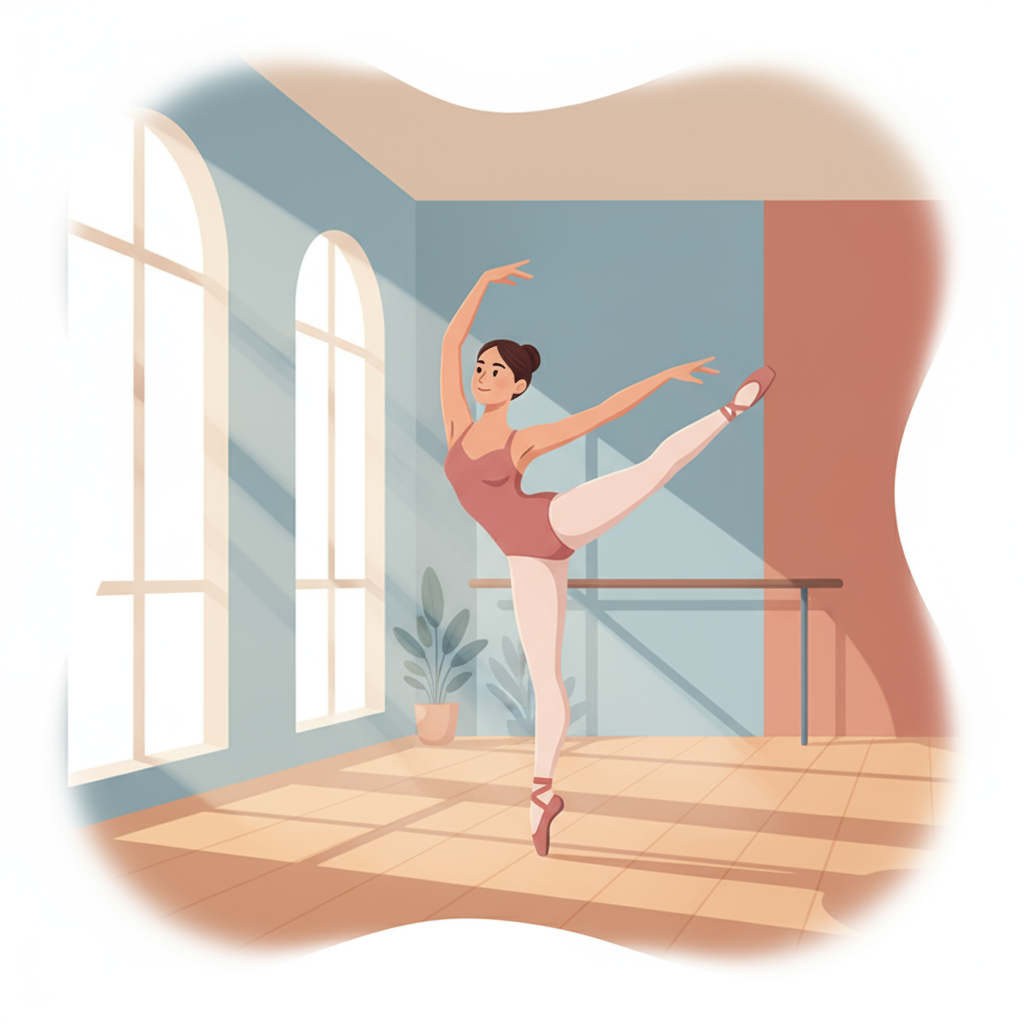
How: Stand in parallel passé, extend your leg back for arabesque, arms in a ‘T’ shape like an airplane. Hold the position and then lower into a plié and rise back up slowly, repeating 5 to 10 times.
Cue: Focus on keeping your body in a straight line from head to toe and keep your pelvis level without twisting.
Habit 2 — Single-Leg Balance With Eyes Closed
Why: Closing the eyes removes visual input, forcing your body’s balance system to rely on proprioception — your sense of body position — improving your stability.
How: Stand on one leg in parallel passé. Close your eyes and try to hold for 30 seconds, gradually working up to 60 seconds.
Cue: Keep your weight evenly distributed on your foot and engage your core to avoid wobbling.
Habit 3 — TheraBand Clock Exercise
Why: This habit strengthens ankles and improves joint stability, which are foundational for balanced dance moves.
How: Tie a TheraBand around a stable object and loop it over your ankle. Relevé (rise onto the balls of your feet) and plié while rotating your leg around an imaginary clock face, moving about 8 directions.
Cue: Maintain proper foot alignment and avoid letting your ankle tilt inward or outward excessively.
Week 1 Schedule
| Day | Habit 1 | Habit 2 | Habit 3 |
|---|---|---|---|
| Monday | 3 sets of 5 reps | 3 rounds of 30s | 2 rounds Clock Rotation |
| Tuesday | 3 sets of 5 reps | 3 rounds of 30s | 2 rounds Clock Rotation |
| Wednesday | Rest or light stretching | Rest | Rest |
| Thursday | 3 sets of 7 reps | 3 rounds of 40s | 2 rounds Clock Rotation |
| Friday | 3 sets of 7 reps | 3 rounds of 40s | 2 rounds Clock Rotation |
| Saturday | 3 sets of 10 reps | 3 rounds of 50s | 3 rounds Clock Rotation |
| Sunday | Rest and recovery | Rest | Rest |
Troubleshooting
Barrier: Feeling frustrated by wobbling and inability to hold balance.
Fix: Break down the habit into smaller sessions with support nearby until your muscles strengthen. Consistency is key to improve balance.
Barrier: Losing motivation to practice daily.
Fix: Set reminders and track progress in a journal. Celebrate small improvements to keep engaged with your goal to improve balance.
Barrier: Muscle fatigue or joint pain during exercises.
Fix: Ensure proper form and avoid rushing through reps. Warm up before practice and rest if you experience pain, then gently return.
FAQs
Q: How long will it take to see noticeable improvement in balance?
A: With consistent use of these simple daily habits, you can start to feel improvements within 2 to 4 weeks, especially as muscles strengthen and proprioception improves.
Q: Do I need special equipment to do these habits?
A: For most habits you only need your body and a small item like a TheraBand for the clock exercise. If no band is available, use a sturdy chair for support instead.
Q: Is it normal to wobble or lose balance while practicing?
A: Yes! Wobbling means your muscles and nerves are working to find control. It is a natural part of improving balance.
Tracking & Motivation Tips
Use a balance journal or app to log how long you can hold your single-leg balances and how many reps you complete. Seeing incremental progress is motivating and reinforces your focus_keyword journey to improve balance. You can also record short videos weekly to visually track your enhanced poise and control over time.
Key Takeaways For Improving Balance
Improving balance as a dancer is achievable with three straightforward daily habits: dynamic airplane balance with pliés, single-leg balance with eyes closed to sharpen proprioception, and ankle strengthening with the TheraBand clock exercise. Consistent practice, attention to form, and tracking progress will steadily build your control, strength, and confidence to perform with grace and stability. Remember, the focus_keyword “improve balance” is a daily journey, and small habits lead to big results.